
Food ordering platform Zomato, whose Rs 9,375 crore IPO opens on July 14, is planning to launch a grocery section on its app soon, a senior company official said. The company recently invested USD 100 million (around Rs 745 crore) for acquiring a minority stake in grocery delivery platform Grofers. "It (grocery) is a large opportunity. The online grocery is nascent right now but is growing rapidly not just in India but across the world... "We are actively experimenting in that space and recently invested $100 million for a minority stake in Grofers, with the idea of getting more exposure to that space and building our strategies and plan around that business," Zomato CFO Akshant Goyal said.

Some of the top indebted companies likely to face financial headwinds in the coming quarters include NTPC, PowerGrid, Tata Steel, Adani Power, JSW Steel, UPL, and Steel Authority of India. Together these 201 companies owed Rs 14.9 trillion to their lenders at the end of September 30, 2019, up 4.1 per cent year-on-year (YoY) during the first half of FY20.

The Centre and states are likely to budget for higher market borrowings to the tune of Rs 2.3 lakh crore next fiscal even though the Union budget may peg a lower-than-expected fiscal deficit for the Centre at 5.8 per cent of GDP, says a report. Icra Ratings anticipates higher redemptions will lead to gross market borrowings of the Centre to rise to Rs 14.8 lakh crore and of the states to jump by Rs 1.6 lakh crore to Rs 9.6 lakh crore, taking the combined borrowings (of the Centre and the states) to Rs 24.4 lakh crore in FY2024, up by 2.3 lakh crore from FY23 combined. In FY23, the Centre's gross borrowings are budgeted at Rs 14.1 lakh crore and of the states at Rs 8 lakh crore, or a combined borrowing of Rs 22.1 lakh crore, according to the agency.

Radio Free Europe reported that the Asian Infrastructure Investment Bank, a Chinese-led development bank, suspended all business with Russia and Belarus on March 3.

Paytm had received the approval for brokerage services from market regulator Sebi in January this year.

Uber Technologies said it is doing a fresh round of recruitment for its India tech centres and is planning to hire 500 more tech employees by December. The app-based mobility and delivery company has a 1,000-member tech team across its centres in Hyderabad and Bengaluru. The firm said the hiring plan is a testament to Uber's commitment to India, and its recognition of the engineering talent in the country. Uber hired 250 engineers to its India teams in 2021.

Both are finding it difficult to sell one each of their plants -- Chennai Maraimalai Nagar (Ford) and Talegaon near Pune (GM) -- and are finding the road blocked by employee severance snarl-ups, report Sohini Das and Shine Jacob.

In the start-up world, hitting the $1-billion mark, which accords the "Unicorn" tag, is a milestone. Enterprises typically reach the milestone only by series C or series D, or three to four funding rounds later. Zeta achieved it at the first one. On May 25, the six-year-old banking tech firm raised $250 million from Japanese conglomerate SoftBank, at a post-money valuation of $1.45 billion. "This is the first time we have raised institutional money," Zeta co-founder Bhavin Turakhia beamed on the conference call. This trajectory is uncommon in start-ups.


India's fertiliser subsidy bill is likely to shoot up by 55 per cent to record Rs 2.5 lakh crore this fiscal as the government will provide additional funds to make up for the spike in cost from higher import price, top sources said on Thursday. The government will ensure that there is no shortage of fertilisers in the country during the kharif (summer-sown) and rabi (winter-sown) season and it is already in talks with major global producers to import key soil nutrients, they added. According to the sources, Union Chemicals and Fertilisers Minister Mansukh Mandaviya is likely to visit many countries, including Saudi Arabia, Oman and Morocco, soon to secure imports on both short and long term basis.

India must remain an integral part of the global economy if it has to grow at 9-10 per cent over the next three decades, Niti Aayog CEO Amitabh Kant said on Tuesday. Speaking at the 15th India Digital Summit, Kant said India needs to become a major global exporting nation, without that it will not be possible to become richer and create wealth for its people over the next three decades.

Microsoft has become the first global Big Tech company to join the Open Network for Digital Commerce (ONDC), an Indian government initiative for developing a first-of-its-kind open network for digital commerce. The world's second-largest technology firm intends to introduce social e-commerce via its app in the Indian market later this year. ONDC is expected to open to the public in Bengaluru over the next fortnight as it enters into the next phase of the pilot for further fine-tuning before rollouts in other cities, according to a source in the know.

Five years after demonetisation, which sought to curb black money and reduce cash circulation in the economy, 70 per cent of respondents said they paid a large component of the total payment towards a real estate transaction in cash. About 16 per cent said they paid over half the amount in cash, observes Shyamal Majumdar.

Indian industry snubbed Google Play's decision to cut by half its commission for developers when they make $1 million in annual revenue for in-app purchases, saying the US tech giant may continue its "abrasive & monopolistic abuse" as it owns the Android system. Google Play said Tuesday that beginning July 1 it would slash its 30 per cent billing fee to 15 per cent for developers globally when they make the first $1 million of their annual revenue.

Ajay Banga, one of the topmost Indian-American corporate leaders, and a strong advocate of India-US relationship, would retire from Mastercard at the end of the year, the global credit card company has said.

Apple issued full-page advertisements on Tuesday.

Everyday consumerables, such as grocery and order-in food items are the key buyout sector, analysts say, and a major reason for kirana stores' digitisation push.

US retail giant Walmart has said it is "open to an IPO" for its Indian e-commerce arm Flipkart but there is "no specific timeline" for the share sale. Both Flipkart and payment app PhonePe continue to do well, Walmart International president and CEO Judith McKenna said while speaking at the DB Access Global Consumer Conference on June 7. "We always made it clear from the day we made the acquisition or the investment, that we would be open to an IPO," said McKenna. However, she noted that there is no specific timeline for the IPO.

Sony Pictures Networks India Pvt Ltd (SPNI) and Zee Entertainment Enterprises Ltd (ZEEL) on Wednesday said they have signed definitive agreements for their merger following conclusion of an exclusive negotiation period during which both parties conducted mutual due diligence. In a joint statement, the two companies said they have "signed definitive agreements to merge ZEEL with and into SPNI and combine their linear networks, digital assets, production operations and program libraries". The agreements follow the conclusion of an exclusive negotiation period during which ZEEL and SPNI conducted mutual due diligence, it added.

Addressing civil servants on the 15th Civil Services Day at Vigyan Bhawan in New Delhi, he said every decision should be evaluated on the basis of its capacity to strengthen the country's unity and integrity.

If there is a morality tale here, it is that debt and death spare no king.

The apparel and engineering sectors have already witnessed the trend in the past one week. If this continues, it can have an impact on the overall export demand in the coming months, considering that Europe is the largest national export market for India.

The central government's clarification on the 2 per cent equalisation levy on foreign digital operators in the Budget, which considerably expands the scope of the levy, might be challenged in court, with several companies contemplating filing a writ petition in the coming few weeks. The writs might be filed on the grounds of the levy's alleged extra-territorial overreach, as it aims to cover those entities that do not have a physical presence in India, going against international taxation rules.

The Reserve Bank on Friday retained the GDP forecast for the current financial year at 9.5 per cent and flagged global semiconductor shortages, elevated commodity prices and potential global financial market volatility as downside risks to economic growth. In his address after the three-day meeting of the rate-setting panel, RBI Governor Shaktikanta Das said recovery in aggregate demand gathered pace in August-September, and it is reflected in high-frequency indicators, like railway freight traffic; port cargo; cement production; electricity demand; e-way bills; GST and toll collections. "The ebbing of infections, together with improving consumer confidence, has been supporting private consumption," he said, and added the pent-up demand and the festival season should give further fillip to urban demand in the second half of the financial year.
The Reserve Bank on Friday approved the transfer of Rs 99,122 crore as surplus to the central government for the accounting period of nine months ended March 31.

Traders who pay in rupees generate over Rs 50 crore in daily cryptocurrency volumes. Indians actually invest a great deal more in forex-denominated trades, observes Devangshu Dutta, explaining why it is impossible to ban cryptocurrency.

Having exposure to international funds and gold is a must for those who have foreign currency-denominated goals.

Demonetisation and Agniveer reveal the two mindsets India has become. In both these government schemes, one sees a desire to play the country like an orchestra anchored by conductor/conductors, argues Shyam G Menon.

If Sebi and RBI remain quiet about this brazenly illegal activity, will someone in the finance ministry or the NITI Aayog take a closer look, asks Debashis Basu.

As many as 2,000 chips are annually designed in India by semi-conductor and fabless companies, Intel India managing director Prakash Mallya said in a conversation with Business Standard. Mallya was reiterating the importance of India in the semi-conductor sweepstakes. "As much as 90 per cent of the semi-conductor companies have a design footprint in India.

The branch managers have come out of their glass cabins and the sellers' market has transformed into a buyers' market, but there is no end to the harassment of customers, asserts Tamal Bandyopadhyay.

India is better positioned to face external shocks emanating from increasing geopolitical tensions, the aftermath of the COVID pandemic and the inevitability of climate change, Reserve Bank Deputy Governor Michael Debabrata Patra said on Monday. Relative to macroeconomic configurations in 2013 when India was described as one of the fragile five countries, he said, "India is better positioned currently, as its macroeconomic fundamentals have improved significantly, and external sector indicators point to the availability of enough cushions to manage external shocks." He was speaking at a conference on 'Growth And Development in the BRICS Economies' organised by the Delhi School of Economics (DSE) and the Indian Statistical Institute (ISI).

'There is a lot of interest from potential clients who have remained away from the markets in past years.' 'They are evaluating whether this is a good time to enter, especially since there are very few alternatives to earn meaningful returns.'
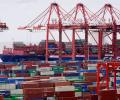
After staging a strong recovery from COVID-induced slowdown in 2021, India's exports are likely to extend the growth story to the New Year also on increased demand in the global markets, boost in domestic manufacturing due to production-linked incentive schemes and implementation of some interim trade pacts. Expectations of positive growth in the country's exports are also backed up by the outlook of the World Trade Organisation (WTO) which predicts a 4.7 per cent expansion in the global merchandise trade volume in 2022. Exporters believe that the outbound shipments would cross $400 billion mark in this fiscal going by the current momentum and may reach $475 billion in 2022-23.

The Reserve Bank of India's (RBI's) move to ban Mastercard from issuing new cards for not complying with the local data storage guidelines may hit five private banks, a non-bank lender, and a major card-issuing company. The impact is expected to be felt for a few months as these players transition to other card networks. According to Nomura Research, RBL Bank, YES Bank, and Bajaj Finserv are the ones most impacted by the ban as all their credit card schemes are allied to Mastercard. Among others, IndusInd Bank, Axis Bank and ICICI Bank have 35-40 per cent of their credit card schemes tied to Mastercard, the report said.

After gaining 300 million mobile wallet users in India, the firm has now expanded operations to Japan via PayPay Corporation, a joint venture established by SoftBank Corp and Yahoo Japan Corporation.

Tata Consultancy Services (TCS) on Wednesday reported a 12.2 per cent rise in its consolidated net profit to Rs 9,769 crore for the December 2021 quarter, and announced Rs 18,000-crore buyback offer for its shareholders at Rs 4,500 per scrip. The country's largest software services firm had logged a net profit of Rs 8,701 crore in the year-ago period. Revenue of the Mumbai-based firm grew 16.3 per cent in the quarter under review to Rs 48,885 crore from Rs 42,015 crore in the corresponding period last fiscal, TCS said in a regulatory filing.

Shaktikanta Das is a master of the finest balancing act who listens to all but takes his own decisions, discovers Tamal Bandyopadhyay.

Moody's and Fitch on Thursday downgraded Russia's sovereign rating to 'junk' grade following severe sanctions by western countries. While Moody's Investors Service downgraded Russia's long-term issuer and senior unsecured (local-and foreign-currency) debt ratings to 'B3' from 'Baa3', Fitch pulled down the rating on the country to 'B' from 'BBB', putting it on 'Rating Watch Negative'. The downgraded rating is in speculative or junk category reflecting default risk. It signifies that even through financial commitments are currently being met, the sovereign is vulnerable to high credit risk.

'This is a good time to restructure your portfolio because the sectors and stocks that performed in the last bull market may not perform as much now.'
